Filters
Question type

Study Flashcards

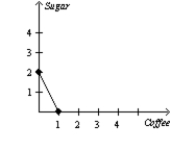
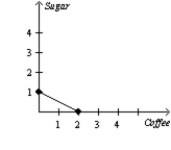
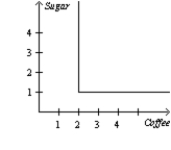
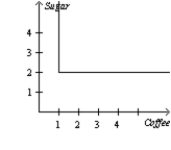
Suppose Caroline will only drink a cup of coffee if she can add two packets of sugar to it. Which graph would illustrate a representative indifference curve?


A) Suppose Caroline will only drink a cup of coffee if she can add two packets of sugar to it. Which graph would illustrate a representative indifference curve? A)    B)    C)    D)
B) Suppose Caroline will only drink a cup of coffee if she can add two packets of sugar to it. Which graph would illustrate a representative indifference curve? A)    B)    C)    D)
C) Suppose Caroline will only drink a cup of coffee if she can add two packets of sugar to it. Which graph would illustrate a representative indifference curve? A)    B)    C)    D)
D) Suppose Caroline will only drink a cup of coffee if she can add two packets of sugar to it. Which graph would illustrate a representative indifference curve? A)    B)    C)    D)

E) A) and D)
F) A) and C)

Correct Answer

verifed

verified

As long as a consumer remains on the same indifference curve,


A) she is indifferent to all points that lie on any other indifference curve.
B) her preferences will not affect the marginal rate of substitution.
C) she is unable to decide which bundle of goods to choose.
D) she is indifferent among the points on that curve.

E) A) and D)
F) B) and C)

Correct Answer

verifed

verified

A family on a trip budgets $800 for meals and hotel accommodations. Suppose the price of a meal is $40. In addition, suppose the family could afford a total of 8 nights in a hotel if they don't buy any meals. How many meals could the family afford if they gave up two nights in the hotel?


A) 1
B) 2
C) 5
D) 8

E) B) and D)
F) A) and B)

Correct Answer

verifed

verified

Figure 21-28 The figure below illustrates the preferences for a representative consumer, Christopher. Figure 21-28 The figure below illustrates the preferences for a representative consumer, Christopher.   -Refer to Figure 21-28. Interest rates increase by 3 percent. Christopher's optimal choice point moves from A to B. Christopher consumes A) less while he is younger and saves more than he did before interest rates increased. B) more while he is younger and saves more than he did before interest rates increased. C) less while he is younger and saves less than he did before interest rates increased. D) more while he is younger and saves less than he did before interest rates increased. -Refer to Figure 21-28. Interest rates increase by 3 percent. Christopher's optimal choice point moves from A to B. Christopher consumes


A) less while he is younger and saves more than he did before interest rates increased.
B) more while he is younger and saves more than he did before interest rates increased.
C) less while he is younger and saves less than he did before interest rates increased.
D) more while he is younger and saves less than he did before interest rates increased.

E) A) and D)
F) A) and C)

Correct Answer

verifed

verified

The theory of consumer choice is to demand as the theory of


A) public goods is to supply.
B) oligopoly is to supply.
C) the competitive firm is to supply.
D) comparative advantage is to supply.

E) B) and C)
F) A) and B)

Correct Answer

verifed

verified

The slope of an indifference curve is


A) the rate of change of consumer's preferences.
B) the marginal rate of preference.
C) the marginal rate of substitution.
D) always equal to the slope of the budget constraint.

E) A) and D)
F) A) and C)

Correct Answer

verifed

verified

Figure 21-10 Figure 21-10   -Refer to Figure 21-10. Which of the following statements is not true for a consumer who moves from bundle B to bundle C? A) At bundle C the consumer would be willing to give up a larger amount of cake in exchange for a donut than at bundle B. B) The marginal rate of substitution at bundles B and C are the same since the points lie on the same indifference curve. C) The consumer is willing to sacrifice donuts to obtain cake. D) The consumer receives the same level of satisfaction at bundles B and C. -Refer to Figure 21-10. Which of the following statements is not true for a consumer who moves from bundle B to bundle C?


A) At bundle C the consumer would be willing to give up a larger amount of cake in exchange for a donut than at bundle B.
B) The marginal rate of substitution at bundles B and C are the same since the points lie on the same indifference curve.
C) The consumer is willing to sacrifice donuts to obtain cake.
D) The consumer receives the same level of satisfaction at bundles B and C.

E) A) and B)
F) A) and C)

Correct Answer

verifed

verified

Figure 21-30 The graph shows two budget constraints for a consumer. Figure 21-30 The graph shows two budget constraints for a consumer.   -Refer to Figure 21-30. Suppose the consumer's income is $90 and Budget Constraint A applies. What is the price of a light bulb? -Refer to Figure 21-30. Suppose the consumer's income is $90 and Budget Constraint A applies. What is the price of a light bulb?

Correct Answer

verifed

verified

The price ...

View Answer

Indifference curves illustrate


A) a firm's profits.
B) a consumer's budget.
C) a consumer's preferences.
D) the prices of two goods.

E) All of the above
F) B) and C)

Correct Answer

verifed

verified

Assume that consumption when young and consumption when old are both normal goods. The income effect of an increase in the interest rate will result in


A) an increase in saving when young.
B) an increase in saving when old.
C) a decrease in saving when young.
D) a decrease in saving when old.

E) A) and D)
F) All of the above

Correct Answer

verifed

verified

Figure 21-11 Figure 21-11   -Refer to Figure 21-11. As the consumer moves from point A to B to C to D, the consumer's total utility A) remains constant. B) increases. C) decreases. D) first increases, then decreases. -Refer to Figure 21-11. As the consumer moves from point A to B to C to D, the consumer's total utility


A) remains constant.
B) increases.
C) decreases.
D) first increases, then decreases.

E) A) and B)
F) C) and D)

Correct Answer

verifed

verified

An indifference curve illustrates the


A) prices facing a consumer as she chooses how much of good X and good Y to consume.
B) income facing a consumer as she chooses how much of good X and good Y to consume.
C) trade-offs facing a consumer as she chooses how much of good X and good Y to consume.
D) All of the above are correct.

E) C) and D)
F) B) and C)

Correct Answer

verifed

verified

Bundle A contains 10 units of good X and 5 units of good Y. Bundle B contains 5 units of good X and 10 units of good Y. Bundle C contains 10 units of good X and 10 units of good Y. The consumer is indifferent between bundle A and bundle B. Assume that the consumer's preferences satisfy the four properties of indifference curves. Which of the following statements is correct?


A) The consumer must prefer bundle C to either bundle A or B.
B) Bundle A and bundle B lie on the same indifference curve.
C) The consumer must prefer bundle B to bundle C.
D) Both a) and b) are correct.

E) B) and C)
F) A) and D)

Correct Answer

verifed

verified

A Giffen good is a good for which


A) an increase in the price raises the quantity demanded.
B) the income effect outweighs the substitution effect.
C) an increase in the price decreases the quantity demanded.
D) Both a) and b) are correct.

E) All of the above
F) B) and D)

Correct Answer

verifed

verified

Assume that a college student purchases only Ramen noodles and textbooks. If Ramen noodles are an inferior good and textbooks are a normal good, then the income effect associated with an increase in the price of a textbook will result in


A) a decrease in the consumption of textbooks and a decrease in the consumption of Ramen noodles.
B) a decrease in the consumption of textbooks and an increase in the consumption of Ramen noodles.
C) an increase in the consumption of textbooks and an increase in the consumption of Ramen noodles.
D) an increase in the consumption of textbooks and a decrease in the consumption of Ramen noodles.

E) All of the above
F) A) and D)

Correct Answer

verifed

verified

Figure 21-5 (a) (b) Figure 21-5 (a)  (b)      -Refer to Figure 21-5. In graph (b) , if income is equal to $420, then the price of good X is A) $1. B) $3. C) $10. D) $30. Figure 21-5 (a)  (b)      -Refer to Figure 21-5. In graph (b) , if income is equal to $420, then the price of good X is A) $1. B) $3. C) $10. D) $30. -Refer to Figure 21-5. In graph (b) , if income is equal to $420, then the price of good X is


A) $1.
B) $3.
C) $10.
D) $30.

E) B) and D)
F) A) and B)

Correct Answer

verifed

verified

The substitution effect in the work-leisure model induces a person to work less in response to higher wages, which tends to make the labor-supply curve slope upward.

A) True
B) False

Correct Answer

verifed

verified

When Matt has an income of $2,000, he consumes 30 units of good A and 50 units of good B. After Matt's income increases to $3,000, he consumes 25 units of good A and 95 units of good B. Which of the following statements is correct?


A) Both goods A and B are normal goods.
B) Both goods A and B are inferior goods.
C) Good A is a normal good, and good B is an inferior good.
D) Good A is an inferior good, and good B is a normal good.

E) A) and D)
F) A) and C)

Correct Answer

verifed

verified

Figure 21-25 The figure pertains to a particular consumer. On the axes, X represents the quantity of good X and Y represents the quantity of good Y. Figure 21-25 The figure pertains to a particular consumer. On the axes, X represents the quantity of good X and Y represents the quantity of good Y.   -Refer to Figure 21-25. Suppose the price of good X is $8, the price of good Y is $10, and the consumer's income is $360. Then the consumer's optimal choice is represented by a point on which curve? A) I<sub>1</sub> B) I<sub>2</sub> C) I<sub>3</sub> D) I<sub>4</sub> -Refer to Figure 21-25. Suppose the price of good X is $8, the price of good Y is $10, and the consumer's income is $360. Then the consumer's optimal choice is represented by a point on which curve?


A) I1
B) I2
C) I3
D) I4

E) None of the above
F) B) and D)

Correct Answer

verifed

verified

The theory of consumer choice illustrates that people face tradeoffs, which is one of the Ten Principles of Economics.

A) True
B) False

Correct Answer

verifed

verified

Showing 121 - 140 of 570

Related Exams

Show Answer