Filters
Question type

Study Flashcards

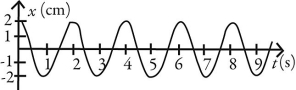
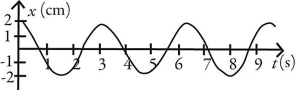
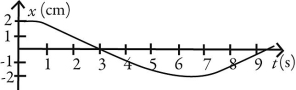
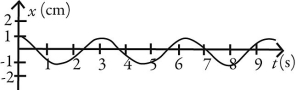
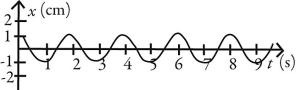
Which of following graphs describes simple periodic motion with amplitude 2.00 cm and angular frequency 2.00 rad/s?


A) Which of following graphs describes simple periodic motion with amplitude 2.00 cm and angular frequency 2.00 rad/s? A)    B)    C)    D)    E)
B) Which of following graphs describes simple periodic motion with amplitude 2.00 cm and angular frequency 2.00 rad/s? A)    B)    C)    D)    E)
C) Which of following graphs describes simple periodic motion with amplitude 2.00 cm and angular frequency 2.00 rad/s? A)    B)    C)    D)    E)
D) Which of following graphs describes simple periodic motion with amplitude 2.00 cm and angular frequency 2.00 rad/s? A)    B)    C)    D)    E)
E) Which of following graphs describes simple periodic motion with amplitude 2.00 cm and angular frequency 2.00 rad/s? A)    B)    C)    D)    E)

F) None of the above
G) A) and B)

Correct Answer

verifed

verified

A large stick is pivoted about one end and allowed to swing back and forth with no friction as a physical pendulum.The mass of the stick is A large stick is pivoted about one end and allowed to swing back and forth with no friction as a physical pendulum.The mass of the stick is   and its center of gravity (found by finding its balance point)is   from the pivot.If the period of the swinging stick is   what is the moment of inertia of the stick about an axis through the pivot? and its center of gravity (found by finding its balance point)is A large stick is pivoted about one end and allowed to swing back and forth with no friction as a physical pendulum.The mass of the stick is   and its center of gravity (found by finding its balance point)is   from the pivot.If the period of the swinging stick is   what is the moment of inertia of the stick about an axis through the pivot? from the pivot.If the period of the swinging stick is A large stick is pivoted about one end and allowed to swing back and forth with no friction as a physical pendulum.The mass of the stick is   and its center of gravity (found by finding its balance point)is   from the pivot.If the period of the swinging stick is   what is the moment of inertia of the stick about an axis through the pivot? what is the moment of inertia of the stick about an axis through the pivot?

Correct Answer

verifed

verified

An object weighing 44.1 N hangs from a vertical massless ideal spring.When set in vertical motion,the object obeys the equation An object weighing 44.1 N hangs from a vertical massless ideal spring.When set in vertical motion,the object obeys the equation   . (a)Find the time for this object to vibrate one complete cycle. (b)What are the maximum speed and maximum acceleration of the object. (c)What is the TOTAL distance the object moves through in one cycle. (d)Find the maximum kinetic energy of the object. (e)What is the spring constant of the spring. . (a)Find the time for this object to vibrate one complete cycle. (b)What are the maximum speed and maximum acceleration of the object. (c)What is the TOTAL distance the object moves through in one cycle. (d)Find the maximum kinetic energy of the object. (e)What is the spring constant of the spring.

Correct Answer

verifed

verified

(a)2.29 s
(b)0.170 ...

View Answer

An object of mass of 2.0 kg hangs from an ideal massless spring with a spring constant of 50 N/m.An oscillating force F = (4.8 N) cos[(3.0 rad/s) t] is applied to the object.What is the amplitude of the resulting oscillations? You can neglect damping.


A) 0.15 m
B) 0.30 m
C) 1.6 m
D) 2.4 m
E) 0.80 m

F) C) and D)
G) B) and E)

Correct Answer

verifed

verified

A 0.28-kg block on a horizontal frictionless surface is attached to an ideal massless spring whose spring constant is A 0.28-kg block on a horizontal frictionless surface is attached to an ideal massless spring whose spring constant is   The block is pulled from its equilibrium position at   to a displacement x = +0.080 m and is released from rest.The block then executes simple harmonic motion along the horizontal x-axis.When the displacement is   find the acceleration of the block. A)  92   B)  46   C)  69   D)  230   E)  280  The block is pulled from its equilibrium position at A 0.28-kg block on a horizontal frictionless surface is attached to an ideal massless spring whose spring constant is   The block is pulled from its equilibrium position at   to a displacement x = +0.080 m and is released from rest.The block then executes simple harmonic motion along the horizontal x-axis.When the displacement is   find the acceleration of the block. A)  92   B)  46   C)  69   D)  230   E)  280  to a displacement x = +0.080 m and is released from rest.The block then executes simple harmonic motion along the horizontal x-axis.When the displacement is A 0.28-kg block on a horizontal frictionless surface is attached to an ideal massless spring whose spring constant is   The block is pulled from its equilibrium position at   to a displacement x = +0.080 m and is released from rest.The block then executes simple harmonic motion along the horizontal x-axis.When the displacement is   find the acceleration of the block. A)  92   B)  46   C)  69   D)  230   E)  280  find the acceleration of the block.


A) 92 A 0.28-kg block on a horizontal frictionless surface is attached to an ideal massless spring whose spring constant is   The block is pulled from its equilibrium position at   to a displacement x = +0.080 m and is released from rest.The block then executes simple harmonic motion along the horizontal x-axis.When the displacement is   find the acceleration of the block. A)  92   B)  46   C)  69   D)  230   E)  280
B) 46 A 0.28-kg block on a horizontal frictionless surface is attached to an ideal massless spring whose spring constant is   The block is pulled from its equilibrium position at   to a displacement x = +0.080 m and is released from rest.The block then executes simple harmonic motion along the horizontal x-axis.When the displacement is   find the acceleration of the block. A)  92   B)  46   C)  69   D)  230   E)  280
C) 69 A 0.28-kg block on a horizontal frictionless surface is attached to an ideal massless spring whose spring constant is   The block is pulled from its equilibrium position at   to a displacement x = +0.080 m and is released from rest.The block then executes simple harmonic motion along the horizontal x-axis.When the displacement is   find the acceleration of the block. A)  92   B)  46   C)  69   D)  230   E)  280
D) 230 A 0.28-kg block on a horizontal frictionless surface is attached to an ideal massless spring whose spring constant is   The block is pulled from its equilibrium position at   to a displacement x = +0.080 m and is released from rest.The block then executes simple harmonic motion along the horizontal x-axis.When the displacement is   find the acceleration of the block. A)  92   B)  46   C)  69   D)  230   E)  280
E) 280 A 0.28-kg block on a horizontal frictionless surface is attached to an ideal massless spring whose spring constant is   The block is pulled from its equilibrium position at   to a displacement x = +0.080 m and is released from rest.The block then executes simple harmonic motion along the horizontal x-axis.When the displacement is   find the acceleration of the block. A)  92   B)  46   C)  69   D)  230   E)  280

F) C) and D)
G) A) and E)

Correct Answer

verifed

verified

A mass M is attached to an ideal massless spring.When this system is set in motion,it has a period T.What is the period if the mass is doubled to 2M?


A) 2T
B) T/2
C) A mass M is attached to an ideal massless spring.When this system is set in motion,it has a period T.What is the period if the mass is doubled to 2M? A)  2T B)  T/2 C)    T D)  4T E)  T T
D) 4T
E) T

F) None of the above
G) All of the above

Correct Answer

verifed

verified

If we double only the mass of a vibrating ideal mass-and-spring system,the mechanical energy of the system


A) increases by a factor of If we double only the mass of a vibrating ideal mass-and-spring system,the mechanical energy of the system A)  increases by a factor of   . B)  increases by a factor of 2. C)  increases by a factor of 3. D)  increases by a factor of 4. E)  does not change. .
B) increases by a factor of 2.
C) increases by a factor of 3.
D) increases by a factor of 4.
E) does not change.

F) C) and D)
G) B) and E)

Correct Answer

verifed

verified

An object is undergoing simple harmonic motion with frequency f = 9.7 Hz and an amplitude of 0.12 m.At t = 0.00 s the object is at x = 0.00 m.How long does it take the object to go from An object is undergoing simple harmonic motion with frequency f = 9.7 Hz and an amplitude of 0.12 m.At t = 0.00 s the object is at x = 0.00 m.How long does it take the object to go from   .00 m to  .00 m to An object is undergoing simple harmonic motion with frequency f = 9.7 Hz and an amplitude of 0.12 m.At t = 0.00 s the object is at x = 0.00 m.How long does it take the object to go from   .00 m to

Correct Answer

verifed

verified

A 2.25-kg object is attached to a horizontal an ideal massless spring on a frictionless table.What should be the spring constant of this spring so that the maximum acceleration of the object will be g when it oscillates with amplitude of 4.50 cm?

Correct Answer

verifed

verified

An object of mass 8.0 kg is attached to an ideal massless spring and allowed to hang in the Earth's gravitational field.The spring stretches 3.6 cm before it reaches its equilibrium position.If this system is allowed to oscillate,what will be its frequency?


A) 2.6 Hz
B) 0.0045 Hz
C) 0.67 Hz
D) 2.1 Hz

E) C) and D)
F) A) and B)

Correct Answer

verifed

verified

A 12.0-N object is oscillating in simple harmonic motion at the end of an ideal vertical spring.Its vertical position y as a function of time t is given by A 12.0-N object is oscillating in simple harmonic motion at the end of an ideal vertical spring.Its vertical position y as a function of time t is given by   . (a)What is the spring constant of the spring? (b)What is the maximum acceleration of the object? (c)What is the maximum speed that the object reaches? (d)How long does it take the object to go from its highest point to its lowest point? . (a)What is the spring constant of the spring? (b)What is the maximum acceleration of the object? (c)What is the maximum speed that the object reaches? (d)How long does it take the object to go from its highest point to its lowest point?

Correct Answer

verifed

verified

(a)466 N/m...

View Answer

A 0.50-kg object is attached to an ideal massless spring of spring constant 20 N/m along a horizontal,frictionless surface.The object oscillates in simple harmonic motion and has a speed of 1.5 m/s at the equilibrium position. (a)What is the amplitude of vibration? (b)At what location are the kinetic energy and the potential energy of the system the same?

Correct Answer

verifed

verified

(a)0.24 m ...

View Answer

A uniform meter stick is freely pivoted about the 0.20-m mark.If it is allowed to swing in a vertical plane with a small amplitude and friction,what is the frequency of its oscillations?


A) 0.55 Hz
B) 0.66 Hz
C) 0.92 Hz
D) 1.1 Hz
E) 1.3 Hz

F) B) and C)
G) B) and E)

Correct Answer

verifed

verified

A 1.5-kg mass attached to an ideal massless spring with a spring constant of A 1.5-kg mass attached to an ideal massless spring with a spring constant of   oscillates on a horizontal,frictionless track.At time   ,the mass is released from rest at   .(That is,the spring is stretched by 10.0 cm.) (a)Find the frequency of the oscillations. (b)Determine the maximum speed of the mass.At what point in the motion does the maximum speed occur? (c)What is the maximum acceleration of the mass? At what point in the motion does the maximum acceleration occur? (d)Determine the total energy of the oscillating system. (e)Express the displacement x as a function of time t. oscillates on a horizontal,frictionless track.At time A 1.5-kg mass attached to an ideal massless spring with a spring constant of   oscillates on a horizontal,frictionless track.At time   ,the mass is released from rest at   .(That is,the spring is stretched by 10.0 cm.) (a)Find the frequency of the oscillations. (b)Determine the maximum speed of the mass.At what point in the motion does the maximum speed occur? (c)What is the maximum acceleration of the mass? At what point in the motion does the maximum acceleration occur? (d)Determine the total energy of the oscillating system. (e)Express the displacement x as a function of time t. ,the mass is released from rest at A 1.5-kg mass attached to an ideal massless spring with a spring constant of   oscillates on a horizontal,frictionless track.At time   ,the mass is released from rest at   .(That is,the spring is stretched by 10.0 cm.) (a)Find the frequency of the oscillations. (b)Determine the maximum speed of the mass.At what point in the motion does the maximum speed occur? (c)What is the maximum acceleration of the mass? At what point in the motion does the maximum acceleration occur? (d)Determine the total energy of the oscillating system. (e)Express the displacement x as a function of time t. .(That is,the spring is stretched by 10.0 cm.) (a)Find the frequency of the oscillations. (b)Determine the maximum speed of the mass.At what point in the motion does the maximum speed occur? (c)What is the maximum acceleration of the mass? At what point in the motion does the maximum acceleration occur? (d)Determine the total energy of the oscillating system. (e)Express the displacement x as a function of time t.

Correct Answer

verifed

verified

(a)0.58 Hz
(b)0.37 m/s,at the...

View Answer

A restoring force of magnitude F acts on a system with a displacement of magnitude x.In which of the following cases will the system undergo simple harmonic motion?


A) F A restoring force of magnitude F acts on a system with a displacement of magnitude x.In which of the following cases will the system undergo simple harmonic motion? A)  F     B)  F   sin x C)  F   x<sup>2</sup> D)  F   x E)  F   1/x A restoring force of magnitude F acts on a system with a displacement of magnitude x.In which of the following cases will the system undergo simple harmonic motion? A)  F     B)  F   sin x C)  F   x<sup>2</sup> D)  F   x E)  F   1/x
B) F A restoring force of magnitude F acts on a system with a displacement of magnitude x.In which of the following cases will the system undergo simple harmonic motion? A)  F     B)  F   sin x C)  F   x<sup>2</sup> D)  F   x E)  F   1/x sin x
C) F A restoring force of magnitude F acts on a system with a displacement of magnitude x.In which of the following cases will the system undergo simple harmonic motion? A)  F     B)  F   sin x C)  F   x<sup>2</sup> D)  F   x E)  F   1/x x2
D) F A restoring force of magnitude F acts on a system with a displacement of magnitude x.In which of the following cases will the system undergo simple harmonic motion? A)  F     B)  F   sin x C)  F   x<sup>2</sup> D)  F   x E)  F   1/x x
E) F A restoring force of magnitude F acts on a system with a displacement of magnitude x.In which of the following cases will the system undergo simple harmonic motion? A)  F     B)  F   sin x C)  F   x<sup>2</sup> D)  F   x E)  F   1/x 1/x

F) A) and B)
G) A) and C)

Correct Answer

verifed

verified

In designing buildings to be erected in an area prone to earthquakes,what relationship should the designer try to achieve between the natural frequency of the building and the typical earthquake frequencies?


A) The natural frequency of the building should be exactly the same as typical earthquake frequencies.
B) The natural frequency of the building should be very different from typical earthquake frequencies.
C) The natural frequency of the building should be almost the same as typical earthquake frequencies but slightly higher.
D) The natural frequency of the building should be almost the same as typical earthquake frequencies but slightly lower.

E) A) and C)
F) None of the above

Correct Answer

verifed

verified

An object is executing simple harmonic motion.What is true about the acceleration of this object? (There may be more than one correct choice.)


A) The acceleration is a maximum when the displacement of the object is a maximum.
B) The acceleration is a maximum when the speed of the object is a maximum.
C) The acceleration is a maximum when the displacement of the object is zero.
D) The acceleration is zero when the speed of the object is a maximum.
E) The acceleration is a maximum when the object is instantaneously at rest.

F) D) and E)
G) A) and B)

Correct Answer

verifed

verified

A frictionless simple pendulum on Earth has a period of 1.75 s.On Planet X its period is A frictionless simple pendulum on Earth has a period of 1.75 s.On Planet X its period is   .What is the acceleration due to gravity on Planet X? .What is the acceleration due to gravity on Planet X?

Correct Answer

verifed

verified

An object is attached to a vertical ideal massless spring and bobs up and down between the two extreme points A and B.When the kinetic energy of the object is a minimum,the object is located


A) at either A or B.
B) midway between A and B.
C) 1/3 of the distance from A to B.
D) 1/4 of the distance from A to B.
E) 1/ An object is attached to a vertical ideal massless spring and bobs up and down between the two extreme points A and B.When the kinetic energy of the object is a minimum,the object is located A)  at either A or B. B)  midway between A and B. C)  1/3 of the distance from A to B. D)  1/4 of the distance from A to B. E)  1/   times the distance from A to B. times the distance from A to B.

F) A) and B)
G) A) and E)

Correct Answer

verifed

verified

A 1.6-kg block on a horizontal frictionless surface is attached to an ideal massless spring whose spring constant is 190 N/m.The block is pulled from its equilibrium position at A 1.6-kg block on a horizontal frictionless surface is attached to an ideal massless spring whose spring constant is 190 N/m.The block is pulled from its equilibrium position at   to a displacement x = +0.080 m and is released from rest.The block then executes simple harmonic motion along the horizontal x-axis.What is the velocity of the block at time   ? A)  0.82 m/s B)  -0.82 m/s C)  0.30 m/s D)  -0.30 m/s E)  0.00 m/s to a displacement x = +0.080 m and is released from rest.The block then executes simple harmonic motion along the horizontal x-axis.What is the velocity of the block at time A 1.6-kg block on a horizontal frictionless surface is attached to an ideal massless spring whose spring constant is 190 N/m.The block is pulled from its equilibrium position at   to a displacement x = +0.080 m and is released from rest.The block then executes simple harmonic motion along the horizontal x-axis.What is the velocity of the block at time   ? A)  0.82 m/s B)  -0.82 m/s C)  0.30 m/s D)  -0.30 m/s E)  0.00 m/s ?


A) 0.82 m/s
B) -0.82 m/s
C) 0.30 m/s
D) -0.30 m/s
E) 0.00 m/s

F) D) and E)
G) All of the above

Correct Answer

verifed

verified

Showing 21 - 40 of 50

Related Exams

Show Answer